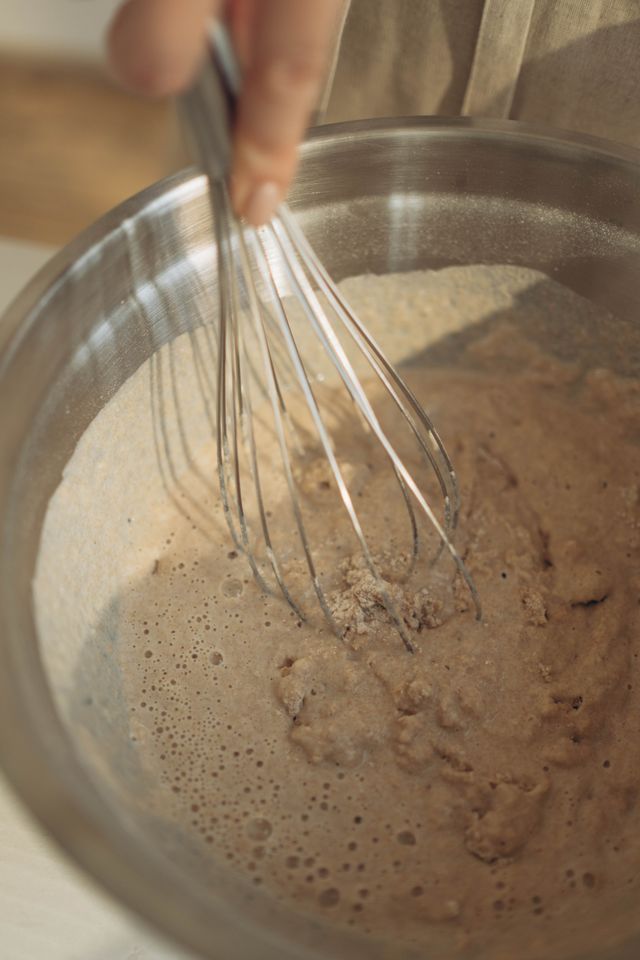
👨🍳 Method
-
1
Understand that roux is a mixture of one-third melted butter and two-thirds flour.
-
2
Note that three main types of roux exist: white, blonde, and brown, depending on the desired color of the final sauce.
-
3
Recognize that the only difference lies in how much the roux is allowed to brown.
-
4
After combining melted butter and flour in a pan over heat, cook the roux briefly while stirring constantly to remove the raw flour taste.
-
5
The longer the roux cooks, the darker it becomes.
-
6
For white roux: Melt the butter and let it foam without browning.
-
7
Add the flour and mix with a whisk.
-
8
Cook gently over low heat, stirring regularly without allowing it to color, to remove the raw flour taste.
-
9
For large quantities, this can also be done in an oven at 160°C, stirring regularly with a whisk.
-
10
After the drying time, white roux should be completely white and ready for further use.
-
11
For blonde roux: Melt the butter and let it foam without browning.
-
12
Add the flour and mix with a whisk.
-
13
Cook gently over low heat, stirring regularly to remove the raw flour taste.
-
14
For large quantities, this can also be done in an oven at 160°C, stirring regularly with a whisk.
-
15
After about 10 minutes, the roux will achieve a straw-yellow color and is ready for further use.
-
16
For brown roux: Melt the butter and let it foam without browning.
-
17
For large quantities, spread the flour on a baking sheet and brown in an oven at 160°C; otherwise, brown it in a non-stick pan over low heat.
-
18
Stir very frequently, as the flour burns easily.
-
19
Add the melted butter and mix with a whisk.
-
20
Cook gently over low heat, stirring regularly to remove the raw flour taste.
-
21
For large quantities, this can also be done in an oven at 160°C, stirring regularly with a whisk.
-
22
After about 20 minutes, the roux will achieve a brown color and is ready for further use.
-
23
Once cooled, this mixture can be stored in a dry place for several weeks and used as needed.
-
24
Ensure it has cooled completely before placing it in a container to avoid a hard cake that is difficult to portion later.
-
25
Essential when using roux: always respect the cold-warm principle—cold roux with hot liquid, warm roux with cold liquid.
-
26
Sauces bound with roux maintain their thickening power very well.
-
27
Therefore, sauces containing an acid (such as lemon juice) or those requiring prolonged warming in a water bath should always be bound with roux.
-
28
For all bindings in soups and sauces that must hold for extended periods, roux is the premier binding agent.
-
29
Proportions for Béchamel sauce: 140 grams white roux per 1 liter milk.
-
30
For Velouté sauces: 110 grams white roux per 1 liter stock, broth, or fumet.
-
31
For Velouté soups: 60 grams white roux per 1 liter stock, broth, or fumet.
-
32
For Cheese croquettes: 180 grams white roux per 1 liter milk.
🤖 Ask the Cooking Assistant about this recipe
Ask a question about this recipe, or request an adjustment (e.g. "make this halal" or "replace flour with a gluten-free alternative").


